

Why You're Still Thinking About That Email
A three-step exercise to get out of your head and back in control

It was 11 pm and I was still mentally replaying the incident that happened at workplace. (My most productive arguments happen at night, apparently, with someone who isn’t even in the room.)
A simple request ended up with a terse email reply that my colleague can no longer support me on this project as she has “other stuff” on her plate. Like that also can, meh?
I am really stewing over that email.
Have you ever replayed such a conversation in your head for hours?
Someone said something that rubbed you the wrong way. You couldn’t stop thinking about it. You found yourself mentally defending your position, imagining better comebacks (the devastating ones that never actually occur to you in the moment!), or wondering why the interaction affected you so much.
I’ve been thinking about this a lot lately.
One of the ideas we learn in coaching is the Iceberg Theory (I’m a volunteer coach at my workplace, and am also working towards my International Coaching Federation (ICF) credential. This concept keeps coming up).
Most of what we see, such as frustration, missed deadlines or conflict, is only the tip of the iceberg. Beneath the surface lie our beliefs, assumptions, emotions and values. Those are often the real drivers of our behaviour.
In many Asian workplaces, what’s beneath the surface stays beneath the surface. We’re not always raised to name our emotions out loud. Which makes the iceberg even bigger, and even harder to navigate.
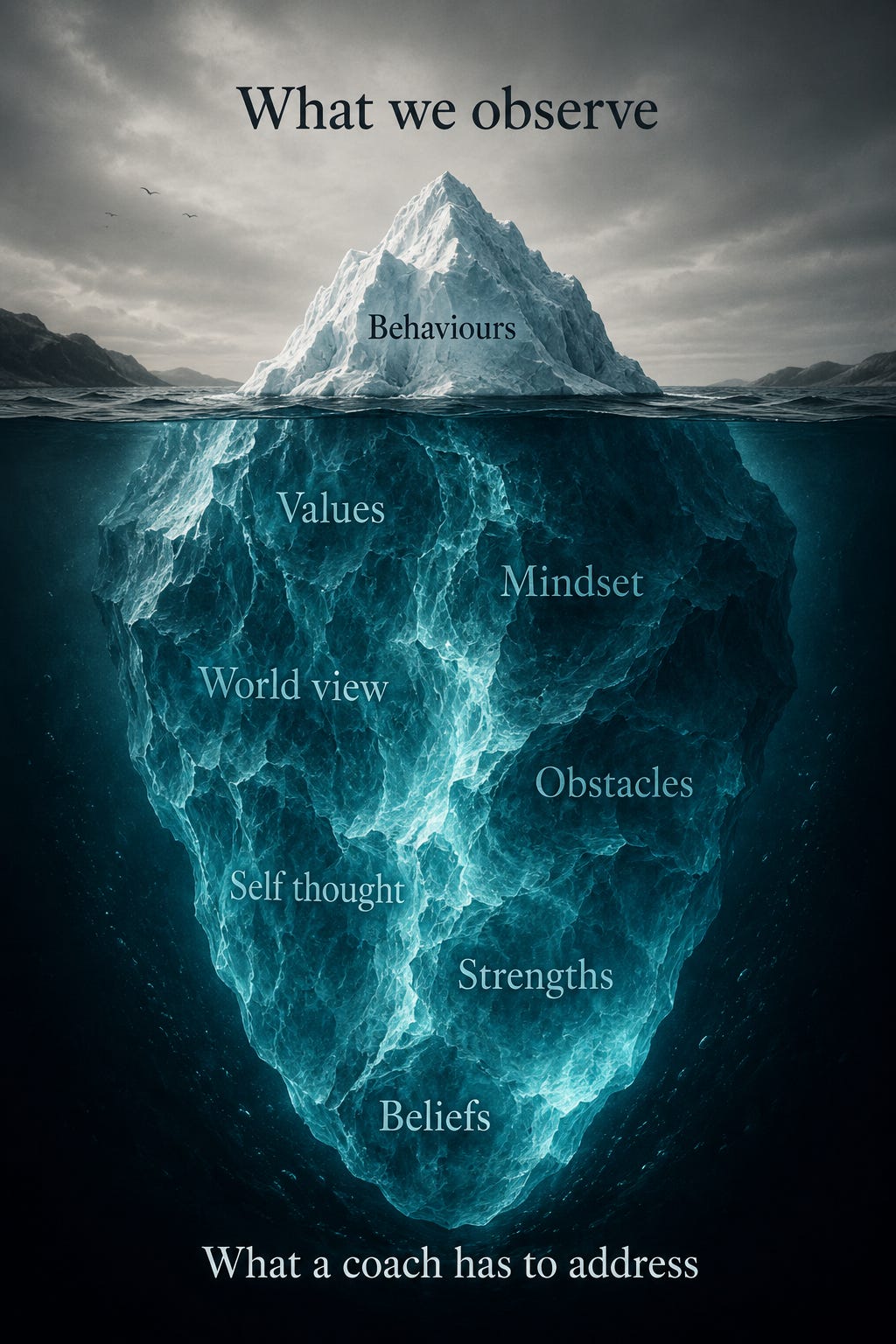
Take a manager who constantly takes work back from the team and redoes it before submission. The team sees someone who doesn’t trust them. The manager probably knows how it looks. And yet, he can’t seem to stop.
This is where a coach earns their place.
Not by pointing out the behaviour. Not by suggesting the manager “delegate more.” But by sitting with him long enough to ask the questions that haven’t been asked yet.
What is the worst thing you fear might happen if you let your team finalise this project?
Where does this need to get it exactly right come from?
When did you first learn that mistakes were not okay?
These aren’t questions you can answer in a hurry. They require someone who is fully present, who isn’t there to judge or fix, and who knows how to hold the silence after you’ve said something that surprises even yourself. That’s what a skilled coach does. They don’t hand you the answer. They help you find the thing underneath the thing — the belief, the old wound, the identity you’ve quietly built your whole career around.
That kind of uncovering changes more than behaviour. It changes how you see yourself.
Which makes me wonder…
What if we don’t have a coach?
Most of us don’t have regular access to an ICF-certified coach. And even if we did, coaching can be expensive.
So can we coach ourselves?
I think we can. Not perfectly, but well enough to uncover some of our own blind spots.
The best time to practise self-coaching is when you’ve had a strong emotional reaction. Maybe you’re furious with a colleague. Maybe a comment from a loved one stings far more than it should. Those moments are often clues that something deeper is going on.
When you have some quiet time, sit with yourself and reflect on what really happened.
Imagine this scenario.
You spent weeks preparing a proposal. During a meeting, your colleague, James, interrupts you several times and dismisses one of your recommendations.
After the meeting, you’re furious.
Your first thought is:
“James has absolutely no respect for me.” (Your second thought is probably a few choice words we won’t put in writing here.)
Most of us stop at “James is disrespectful.” But that conclusion closes a door. The questions open it back up.
Here’s a simple three-step exercise.
Step 1: Separate the Facts from the Story
Ask:
• What actually happened?
• What would a video camera have recorded?
• What am I adding to the story?
Step 2: Explore What’s Beneath the Emotion
Ask:
• What is underneath the anger?
• Why does this bother me so much?
• What belief or assumption am I holding?
• What value feels threatened?
Step 3: Choose Your Response
Ask:
• Is my interpretation the only possible one?
• How do I want to respond in a way that reflects my values?
The goal of self-coaching isn’t to convince yourself that the other person was right.
James may indeed have behaved inappropriately.
The goal is to separate what happened, what it meant to you, and the assumptions you filled in, so that your response is guided by your values rather than by your initial emotional reaction.
The next time you find yourself replaying a conversation in your head, don’t rush to find the answer.
Instead, ask yourself a better question.
You might discover that the real conversation isn’t with the other person.
It’s with yourself.
Brinny is a mid-lifer and a mum, writing from inside a demanding corporate career and a full life in Singapore. Subscribe for bite-sized wisdom to help you build a happier life and a career you love.
I can relate to this really well and I appreciate the questions you've listed. I'm also someone who thinks a lot at night (that's the quietest moment and there's no distraction so I'm not surprised!) and used to let conflict affect my sleep, albeit unwillingly. But I've since been able to separate myself from it. I especially like the part where you pointed readers towards, why does the conflict affect me so? Too many times we focus on the person who made us angry without wondering why we're angry.